

Policy Brief: Turning Population into Productivity

A Human Capital Reform Agenda for Nigeria
Nigeria’s human capital problem is a system challenge. The institutions responsible for developing and deploying human capital are not consistently converting its very large and youthful population into skilled, healthy and productive people capable of creating economic value and earning decent incomes. This blog highlights the dual challenge facing Nigeria where the country is unable to develop adequate human capital early in life and is unable to use the human capability developed in productive activities. Thus, the policy solutions proposed in this blog must involve a link between health, education, training and jobs. [3][6][7].
This policy brief agrees that Nigeria should treat human capital as an integrated system. It argues, however, that this should go further by treating human capital as a single national productivity system, with the objective of strengthening the full pathway from early childhood health and nutrition, through foundational learning and market-relevant skills, to productive work, while holding institutions accountable for outcomes rather than activities.
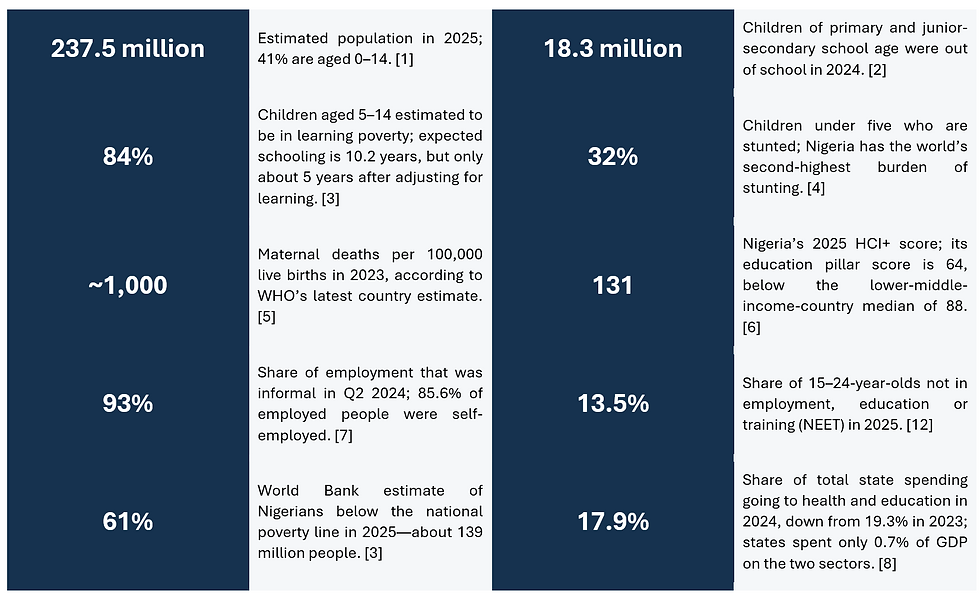
Key Data
Nigeria’s human capital challenge at a glance
Introduction
Human capital refers to the resources of health, knowledge, skills, capabilities and experience which allow an individual to live a productive life and add value to the economy. In the case of Nigeria, this is especially significant due to the combination of a huge population with a youthful age composition. According to UNFPA, Nigeria has a population of 237.5 million people in 2025, with 41% of those being under the age of 15 years old. [1][3]
This demographic scale can become an advantage only if children survive and develop well, learn in school, acquire relevant skills, and participate in work that becomes progressively more productive over time. The World Bank’s new Human Capital Index Plus (HCI+) makes this link explicit by measuring human capital across health, education and employment. Nigeria’s 2025 HCI+ score of 131 is slightly above the Sub-Saharan African average of 127, yet the education pillar is weak, and the World Bank further estimates that raising effective years of schooling to 12 could increase long-run labour earnings by about 20%. [6]
Nigeria currently treats human capital through an increasingly integrated policy architecture spanning health and nutrition, education, skills and labour-force participation. HCD 2.0 has strengthened this whole-of-government orientation, but delivery remains distributed across sectors, institutions and levels of government, with uneven coordination and accountability across the pathway from human development to productive economic participation. [9]
Why the Problem Matters
Scale, talent and work participation are available in Nigeria, but insufficient amounts of these assets are being translated into learning, good health, productivity of businesses and increased income levels among households. The deficiencies are interconnected. Malnutrition reduces learning capacity; poor learning reduces skills; low skills drive people to engage in unproductive activities; unproductivity limits income and resources; and poor government finances constrain the quality of health and educational services. [3][4][7][8]
Education
Access forms the root of the educational problem. According to UNICEF in 2024, 10.2 million children in primary schools and 8.1 million children in junior secondary schools were not enrolled in schools. UNICEF also reported that 74 percent of 7-to-14-year-olds could not read or do basic math. The most recent estimate by the World Bank indicates that 84 percent of 5-to-14-year-olds are in learning poverty. Despite being able to attend school for 10.2 years, Nigerian children will only actually learn for five years. [2][3]
This implication of the policy is significant. Increasing enrollment in schools without enhancing the quality of learning in the classroom may result in an increased number of years spent in school without creating the same level of human capital. The capability of teachers, teaching material, school administration, school attendance, security, and basic skills of literacy and numeracy are thus as important as the level of enrollment. This is especially difficult to do in light of regional inequalities and insecurity in certain states. [2][3]
Health and nutrition
Human capital formation begins even before children step into a classroom. According to UNICEF, 32% of the children in Nigeria under the age of five years suffer from stunting, and malnutrition is either directly or indirectly responsible for 45% of deaths in under-five children in Nigeria. The World Health Organization’s most recent estimate puts the maternal mortality rate in Nigeria at about 1,000 deaths per 100,000 live births in 2023. [4][5]
Economic gains from investment in early-life interventions are immense. The World Bank’s Nigeria 2026 strategy states that if childhood stunting were ended, there would be an increase in wages of around 13%. The World Bank’s 2026 strategy notes that more than half of Nigeria’s early-childhood human capital shortfall results from child survival rates, with stunting and pre-primary schooling coming second and third respectively. [3]
Skills and employability
The Nigerian labour market highlights the disparity between qualification and productivity. According to the World Bank, the education pillar score in the 2025 HCI+ index for Nigeria is 64, compared to 88 for median low-middle income countries, and tertiary completion rate stands at 11.3%. Furthermore, the 2025 private sector diagnostic highlights lower learning-adjusted years of schooling and low tertiary enrollment as barriers to qualified labour supply for high-skill jobs. [6][10]
The solution cannot be addressed simply through expansion of the university system. Nigeria requires better technical and vocational tracks, better apprenticeship systems, better digital skills and management skills, and systems where the curriculum and training can be modified to suit employer demands. The 2026 Human Capital Report emphasizes the fact that learning does not stop at school but goes on at work, and that self-employment and micro-enterprises provide very poor job learning opportunities. [11]
Employment
Headline unemployment can give a misleadingly reassuring picture. Under the current NBS methodology, unemployment was 4.3% in Q2 2024 and 6.5% among 15–24-year-olds. Yet 93% of employment was informal, 85.6% of employed people were self-employed, only 14.4% were employees, and 12.5% of young people were not in employment, education or training. The development challenge is therefore less about whether Nigerians do any work and more about whether work is productive, secure, remunerative and capable of building skills over time. [7]
This is important because human capital can be considered to have national value only if utilized. According to a report by the World Bank, wage increases of as much as 15% may be achieved through decreasing the number of youth who are unemployed and not studying. Thus, policies aimed at improving education alone, but not changing the nature of economic activities, will not achieve their full impact. [3]
Governance
The nature of human capital development is necessarily cross-sectoral; however, the delivery architecture in Nigeria is fragmented. Education, health care, nutrition, skill development, labour market policies and social protection are spread out amongst different ministries, agencies and levels of government. The World Bank notes that Nigeria’s federal architecture fragments responsibility for financing and managing core services, particularly basic education and primary healthcare, while the 36 states remain central to actual human-capital outcomes. [3]
The new HCD 2.0 framework thus makes sense in focusing on integration and information. However, coordination is only going to be effective if it changes incentives and behavior. If there is a dashboard with indicators not connected to government planning, budgeting, management and correction, it is liable to become just another reporting tool. Nigeria requires a system in which there are a few outcomes that are jointly owned, measured and financed. [9]
Financing
Nigeria’s fiscal limitation is real, but so is its inefficiency issue. According to a World Bank analysis in 2026, “health and education receive less money relative to their peers and the budget share for health and education in states was 19.3% of total state budget outlay in 2023 compared to 17.9% in 2024.” Despite playing a vital role in the delivery of public services, the state budgeted only 0.7% of GDP towards health and education in 2024. The same assessment finds substantial room to improve spending efficiency in both sectors. [8]
The right policy question here then becomes whether Nigeria can shield high-reward human-capital investments, free up money reliably, increase spending on front-line programs, cut back on leakage and fragmentation, and track whether more naira translate into improved chances of surviving, learning, and working. Fiscal reform and human-capital reform must be seen as complementary not conflicting policy agendas. [8]
Demography
Nigeria’s age structure creates a time-bound opportunity. As the working-age share of the population rises relative to dependents, growth can accelerate but only when people are healthy, skilled and productively employed. According to World Bank estimates, Nigeria’s population could touch 400 million by 2050 with approximately 180 million being young people. In case current shortages continue, the very same demographic weight will put further strain on educational institutions, healthcare facilities, employment markets, government budgets, and social fabrics. [3]
The cost is already visible in household welfare. The World Bank estimates that 61% of Nigerians—about 139 million people—were below the national poverty line in 2025. Human capital is not the only driver of poverty, but weak health, learning and job quality reduce the capacity of growth to translate into sustained improvements in living standards. [3]
Policy Recommendations
Convert HCD 2.0 into Federal–State Human Capital Delivery Compacts.
HCD 2.0 already provides a national framework for human-capital development, including state-level coordination structures, implementation arrangements and a dashboard for monitoring outcomes. However, implementation remains uneven across states, with differences in institutional capacity, coordination and political prioritization affecting the extent to which the framework is being translated into action. [9] Federal Government support should therefore be targeted to the specific implementation constraints preventing individual states from delivering HCD 2.0 outcomes.
Scale What Works in Early Human-Capital Development.
Federal and state governments should move beyond expanding existing programmes to systematically identify, test and scale interventions that demonstrate measurable improvements in early health, nutrition and learning. Development partners can provide technical expertise, innovation and independent evidence, while government provides the systems and financing needed to take successful approaches to scale. For example, the Kano Literacy and Mathematics Accelerator (KaLMA) which started in 2019 and concluded in 2024, demonstrated how government–development partner collaboration can test an approach, establish results and support its wider adoption. The priority should be to find what works, demonstrate that it works, and scale it through government systems.
Measure Skills by Employment Outcomes.
There are already existing frameworks linking skills development, apprenticeships and industry demand, including the NSQF and IDEAS programme. [10][11] The Federal Government should build on these systems by routinely tracking what happens to participants after training whether they find work, what they earn, whether their productivity improves and whether employers value the skills acquired. Skills programmes should ultimately be judged by whether training translates into productive work and improved livelihoods.
Make Productive Work a Human-Capital Outcome.
HCD 2.0 already recognizes labour-force participation and livelihoods as a core component of human-capital development. [9] The National HCD Programme should go further by measuring whether work enables people to use and build their skills, increase their productivity and improve their earnings over time. This is particularly important in a labour market where 93% of employment is informal. [7] The measure of success should be that people have work and that work is productive and economically rewarding.
Conclusion
The human capital problem facing Nigeria is not insurmountable. The overarching approach to solving it is to ensure that investments in health, education, skills and labour complement each other to generate capabilities that can be utilized productively by people throughout their lives. Human Capital Development 2.0 offers an important framework for doing so. [9] The government needs to bridge the gap in implementation from state to state, scale what works, link skill acquisition to productivity, and see if the work done has been becoming more productive and economically valuable for the individual. The demographic advantage of the country will come down to how well Nigeria converts its investments in people into productive capabilities that have real economic value.
References
[1] United Nations Population Fund. (2025). Nigeria population 2025. World Population Dashboard.
[2] United Nations Children’s Fund. (2024, September 9). Immediate action needed to protect Nigeria’s children and schools. UNICEF Nigeria.
[3] World Bank. (2026). Nigeria country partnership framework for the period FY2026–2032. World Bank Group.
[4] Federal Ministry of Budget and Economic Planning & United Nations Children’s Fund Nigeria. (2024). Situation analysis of children and adolescents in Nigeria, 2024. Federal Government of Nigeria & United Nations Children’s Fund Nigeria.
[5] World Health Organization, United Nations Children’s Fund, United Nations Population Fund, World Bank Group, & United Nations Department of Economic and Social Affairs, Population Division. (2025). Trends in maternal mortality 2000 to 2023: Estimates by WHO, UNICEF, UNFPA, World Bank Group and UNDESA/Population Division. World Health Organization.
[6] World Bank. (2026, February 12). Current deficits in nutrition, learning, and on-the-job skills are costing children born today half of their future earnings.
[7] National Bureau of Statistics. (2024). Nigeria labour force survey: Q2 2024.
[8] World Bank. (2025). Nigeria development update, October 2025: From policy to people: Bringing the reform gains home. World Bank.
[9] The State House. (2025, April 14). Nigeria restates resolve to rank among top 80 nations on Global Human Capital Index. The State House, Abuja.
[10] World Bank Group. (2025). Nigeria country private sector diagnostic. World Bank Group.
[11] World Bank. (2026). Building human capital where it matters: Homes, neighborhoods, and workplaces. World Bank.
[12] World Bank. (2026). Share of youth not in education, employment or training, total (% of youth population) (modeled ILO estimate) – Nigeria. World Development Indicators.
Author's Bio

Dr Henry Akwuebu is a Fellow of the Abuja School of Social and Political Thought, a pioneer member of the Africa Public Policy and Governance Network (APPGN), and Head of Policy and Evidence at EMPIRICAL, where he leads policy research, analysis and evidence-informed policy engagement. He is also a contributor to Econolicy, an African policy research and journalism platform focused on economic trends and public policy.
Comments